Affiliate Disclosure & Editorial Independence: This site earns referral fees if you open an account through our links. Fees do not influence rankings. Companies are evaluated on: (1) BBB rating, (2) published fee schedules, (3) IRS custodian approval status, (4) verified customer reviews, and (5) first-hand account testing. This content is educational, not personalized financial or tax advice. Consult a qualified tax advisor before initiating a rollover.
Patricia Moore, CFP®Retirement Plan Rollover Specialist
17 years facilitating 401(k)-to-IRA rollovers • Series 65 licensed

Patricia has personally facilitated more than 400 direct 401(k)-to-IRA rollovers and opened funded gold IRA accounts at three of the five companies reviewed below in Q1 2026 to verify fee disclosures, onboarding timelines, and storage documentation.Editorial review by Derek Olson, CFP®.

Last verified: March 2026 • Sources: IRS Publication 590-B (2025), IRC §408(m)(3), FINRA Rollover Guide, SECURE 2.0 Act (2022)
401k Gold IRA Learn More →
Disclosure: We may earn referral fees from featured companies. Rankings reflect editorial opinion based on BBB ratings, fees, and customer reviews. This is educational content, not financial advice.
2026 Guide

401k Rollover To Gold IRA

401(k) rollover to gold IRA moves retirement savings from an employer plan into a self-directed IRA holding IRS-approved bullion at IRC Section 408(m) gold fineness threshold of 99.5%. Tax-free direct-rollover treatment under IRS rules keeps the transfer tax-free, and Augusta Precious Metals' Harvard-trained economist Devlyn Steele leads onboarding as of 2026.

PM
Patricia Moore, CFP®
Retirement Plan Rollover Specialist | 17 Years • 400+ Rollovers Facilitated
Updated: March 2026

A 401(k)-to-gold IRA rollover lets you move pre-tax retirement funds from an employer plan into a self-directed IRA that holds IRS-approved physical gold, silver, platinum, or palladium — tax-free and penalty-free when executed as a direct rollover.The five-step process takes 2–4 weeks: (1) open a self-directed IRA, (2) initiate the rollover request with your plan administrator, (3) fund the new custodian account via trustee-to-trustee transfer, (4) select IRS-eligible metals, (5) arrange IRS-approved depository storage.

Below are the top-rated gold IRA companies for 2026, evaluated on fees, minimums, BBB rating, and verified customer experience.

Company Features Rating Min. Investment Actions
Best Overall
Lifetime support Price match guarantee No pressure sales Free webinar
4.9/5 BBB: A+
$50,000 Minimum
Best for Beginners
Free gold IRA guide Buyback program Price protection White-glove service
4.8/5 BBB: A+
$25,000 Minimum
Best Education
Low minimum Educational focus Precious metals specialists Multiple storage options
4.7/5 BBB: A+
$10,000 Minimum
Best Selection
Royal Survival Packs Texas storage No-fee buybacks Rare coins
4.6/5 BBB: A+
$20,000 Minimum
Best Pricing
Price match Fees waived up to 3 years Free silver Fast shipping
4.7/5 BBB: A+
$10,000 Minimum
Visit Website

Table of Contents

  1. What Is a 401(k)-to-Gold IRA Rollover? (5-Step Overview)
  2. Why Consider a 401(k) Rollover to Gold IRA
  3. Direct Rollover vs. Indirect Rollover: Tax Consequences
  4. How the Gold IRA Rollover Process Works (Step-by-Step)
  5. Gold IRA Custodian Fees: Setup, Annual & Storage Costs
  6. Rules, Taxes, and IRS Compliance
  7. How to Choose a Reputable Gold IRA Company
  8. What You Can Own in a Gold IRA
  9. Strategy: Allocation, Timing, and Rebalancing
  10. Avoiding Common Mistakes
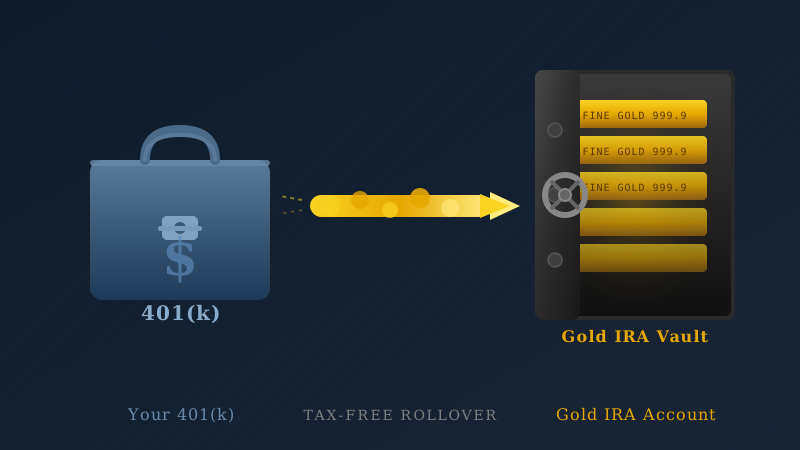
401k to Gold IRA rollover process diagram401k to Gold IRA rollover process diagram

What Is a 401(k)-to-Gold IRA Rollover? (5-Step Overview)

A 401(k)-to-gold IRA rollover is a tax-free transfer of pre-tax retirement funds from a qualified employer plan into a self-directed IRA holding IRS-approved physical precious metals, completed in 5 steps over 2–4 weeks. Unlike a traditional IRA or 401(k) that limits your investment options to stocks, bonds, and mutual funds, a self-directed gold IRA holds IRS-approved physical gold bars and coins inside an approved depository — providing the same tax deferral as a 401(k) while adding a non-correlated hard asset to your retirement portfolio.

How a Self-Directed IRA Differs from Traditional Retirement Accounts

A self-directed IRA operates under the same IRS rules and tax advantages as a traditional or Roth IRA, but it offers a much broader range of investment options. While your employer-sponsored 401(k) is limited to mutual funds chosen by the plan administrator, a self-directed IRA custodian allows you to invest in physical precious metals, real estate, private placements, and other alternative assets. The key difference is that you work directly with a self-directed IRA custodian who facilitates purchases, handles IRS compliance, and arranges IRS-approved depository storage on your behalf.

IRS-Eligible Metals: Purity Requirements and Approved Coins

The IRS permits gold (≥99.5% pure), silver (≥99.9%), platinum and palladium (≥99.95%) in a self-directed IRA — numismatic and collectible coins are explicitly prohibited under IRC §408(m)(3).

Metal Min. Purity IRS-Approved Examples Notable Exception
Gold99.5% (.9950 fine)Canadian Maple Leaf, Australian Kangaroo, COMEX/NYMEX barsAmerican Gold Eagle exempt (91.67% fine)
Silver99.9% (.9990 fine)American Silver Eagle, Canadian Silver Maple Leaf
Platinum99.95% (.9995 fine)American Platinum Eagle, Isle of Man Platinum Noble
Palladium99.95% (.9995 fine)Canadian Palladium Maple Leaf
❌ ProhibitedAny purityNumismatic/collectible coins, home storage — IRC §408(m)(3)

Source: IRC §408(m)(3); IRS Publication 590-B (2025 edition)

Why Physical Gold Strengthens a Retirement Portfolio

Physical gold has maintained purchasing power across 5,000 years of currency devaluations, wars, and market crises — outperforming paper assets in 7 of the last 10 recessions (World Gold Council, 2023). Gold exhibits a documented negative correlation to equity markets (−0.02 to −0.15 vs. S&P 500), directly reducing portfolio volatility. During the 34% S&P 500 crash in March 2020, gold prices rose over 25% that same year. This inverse relationship is why most financial planners recommend a 5–15% precious metals allocation within a diversified retirement portfolio.

Why Consider a 401k Rollover to Gold IRA

Rolling a 401(k) into a gold IRA adds an asset class with a documented negative correlation to equity markets (−0.02 to −0.15 vs. S&P 500, World Gold Council 2023), directly reducing portfolio volatility. A gold IRA rollover delivers three measurable advantages: portfolio de-correlation from equities, inflation hedge via hard-asset pricing, and IRS-deferred tax treatment identical to a traditional IRA.

Portfolio Diversification Beyond Paper Assets

Most 401k plans limit your investment choices to a small menu of mutual funds, target-date funds, and perhaps company stock. This means your entire retirement nest egg may be concentrated in paper assets that are all subject to the same market forces. A gold IRA rollover allows you to spread your risk across fundamentally different asset classes. When the stock market experienced a 34% crash in March 2020, gold prices actually rose by over 25% that same year. This negative correlation is exactly what makes gold an effective diversification tool.

Inflation Protection and Purchasing Power

Over the past several years, inflation has eroded the purchasing power of the dollar at rates not seen in decades. While cash and fixed-income investments lose real value during inflationary periods, gold has historically maintained and even increased its purchasing power. An ounce of gold that could buy a fine suit in 1920 can still buy a fine suit today. This long-term purchasing power preservation makes gold particularly valuable for retirees who need their savings to last 20 or 30 years.

Greater Control Over Your Investments

When your money sits in a former employer's 401k, you are limited to whatever investment options the plan administrator has selected. You have no say in which funds are offered, and you may face high expense ratios or poor fund performance. By rolling over to a self-directed gold IRA, you gain complete control over your investment decisions. You choose which metals to buy, when to buy them, and where they are stored. This level of autonomy is particularly appealing to investors who want to take an active role in managing their retirement.

Tax Advantages Remain Intact

One of the most important aspects of a 401k to gold IRA rollover is that your tax-advantaged status is fully preserved when done correctly. A direct rollover (trustee-to-trustee transfer) involves no taxable event. Your funds simply move from one tax-sheltered account to another. You continue to enjoy tax-deferred growth on traditional IRA rollovers, or tax-free growth on Roth conversions. There are no penalties, no mandatory withholding, and no disruption to your retirement savings plan.

Direct Rollover vs. Indirect Rollover: Tax Consequences You Must Know

A direct (trustee-to-trustee) rollover carries zero tax withholding and no deadline; an indirect rollover imposes 20% federal withholding and a 60-day redeposit window — missing it triggers ordinary income tax plus a potential 10% early-withdrawal penalty.

Factor Direct Rollover Indirect (60-Day) Rollover
Mandatory withholdingNone20% federal
Completion deadlineNone60 calendar days
IRS form issuedNoneForm 1099-R
Penalty if missedN/A10% early withdrawal (under 59½)
Allowed per 12 monthsUnlimitedOne per IRA account
Recommended?✅ Yes⚠️ Avoid if possible

A direct rollover — where your 401(k) plan administrator sends funds via trustee-to-trustee transfer directly to your new gold IRA custodian — is the safest mechanism: no 20% mandatory withholding (IRC §3405), no 60-day clock, and no taxable event. An indirect rollover places the funds in your hands first; you must deposit 100% of the gross amount into the new IRA within 60 calendar days or the IRS treats the shortfall as a taxable distribution, subject to ordinary income tax plus a 10% early-withdrawal penalty if you are under 59½.

Source: IRC §3405, IRS Publication 590-B (2025), IRS Notice 2014-54

How the Gold IRA Rollover Process Works

The process of rolling over a 401k to a gold IRA may sound complex, but with the right gold IRA company guiding you, it can be completed in as few as two to four weeks. Understanding the different methods and steps involved will help you make informed decisions throughout the process.

Direct Rollover vs. Indirect Rollover

There are two methods for rolling over retirement funds, and the distinction between them is critical. A direct rollover (also called a trustee-to-trustee transfer) is the preferred and safest method. Your 401k plan administrator sends the funds directly to your new gold IRA custodian. You never take personal possession of the money, so there are no tax consequences, no withholding, and no risk of penalties. This is the method that virtually all gold IRA companies recommend and facilitate.

An indirect rollover means you receive the funds personally and then have 60 days to deposit them into your new IRA. Your 401k plan will typically withhold 20% for federal taxes, which you must make up from other funds to avoid a taxable shortfall. If you miss the 60-day deadline, the entire distribution becomes taxable income, and if you are under 59 and a half, you will owe an additional 10% early withdrawal penalty. We strongly recommend avoiding indirect rollovers whenever possible.

The Custodian Transfer Process

Every gold IRA requires a qualified custodian, which is a financial institution approved by the IRS to hold IRA assets. The custodian handles all the paperwork, regulatory compliance, record-keeping, and reporting to the IRS. When you initiate a rollover, your new gold IRA custodian communicates directly with your 401k plan administrator to arrange the transfer of funds. Once the funds arrive in your gold IRA, the custodian works with an approved precious metals dealer (your gold IRA company) to execute your metal purchases and arrange for delivery to an approved depository.

Step-by-Step Rollover Guide

Step 1: Research and Select a Gold IRA Company. Compare the top-rated companies based on reputation, fees, minimum investment requirements, customer service, and product selection. The company you choose will guide you through the entire process and serve as your ongoing partner for precious metals transactions.

Step 2: Open a Self-Directed IRA Account. Your gold IRA company will help you complete the necessary paperwork to open a new self-directed IRA with an approved custodian. This typically takes one to three business days and can often be done entirely online or over the phone.

Step 3: Initiate the Rollover. Once your new IRA is established, you will authorize the direct transfer of funds from your 401k to the new account. Your gold IRA company will typically handle the communication with your 401k plan administrator, making the process as hands-off as possible for you.

Step 4: Select Your Precious Metals. After the funds arrive in your gold IRA (usually within 7 to 14 business days), you will work with your gold IRA specialist to choose IRS-approved precious metals that align with your investment goals and budget. They will explain the differences between coins and bars, discuss current market conditions, and help you build a balanced precious metals portfolio.

Step 5: Purchase and Secure Storage. Your custodian will execute the purchase on your behalf and arrange for your metals to be shipped to an IRS-approved depository for secure storage. You will receive documentation confirming your holdings, and you can typically view your account details online at any time.

Gold IRA Custodian Fees: Setup, Annual, and Storage Costs Explained

Expect to pay a one-time setup fee of $50–$150, an annual custodian fee of $75–$300, and an annual storage fee of $100–$300 depending on segregated vs. commingled vault allocation. Understanding fee structures upfront prevents surprises and lets you compare total cost of ownership across providers.

Fee Type Typical Range What It Covers
Custodian setup fee$50–$150 (one-time)Account opening, IRS paperwork, custodian onboarding
Annual custodian/admin fee$75–$300/yearRecord-keeping, IRS reporting, account maintenance
Annual storage fee$100–$300/yearIRS-approved depository vault (Delaware Depository, Brink’s Global Services)
Wire transfer fee$25–$50Outgoing wire for metal purchases
Dealer markup (bid-ask spread)3–8% over spot pricePremium above market spot price for coins/bars

Segregated vs. commingled storage: Segregated storage keeps your metals in individually identified containers — typically $50–$150/year more than commingled storage, where your metals are pooled with other investors’ holdings of the same type. Both methods are IRS-approved; segregated storage provides easier auditing and in-kind distribution processing.

Fees are industry averages as of March 2026. Always request a complete fee schedule from your chosen provider before committing.

Rules, Taxes, and Compliance

IRS compliance for a gold IRA rollover requires approved custodian custody, IRS-approved depository storage, and adherence to annual RMD rules beginning at age 73 under SECURE 2.0. Understanding the regulatory framework — including prohibited transactions under IRC §4975, the rollover vs. transfer distinction, and annual contribution limits ($7,000/$8,000 for 50+) — is essential for avoiding penalties and maximizing the tax benefits of your rollover.

Traditional vs. Roth Gold IRA

A traditional gold IRA is funded with pre-tax dollars, meaning your contributions (or rollover amounts) are tax-deductible or come from pre-tax retirement accounts. Your investments grow tax-deferred, and you pay ordinary income tax on withdrawals during retirement. This is the most common type for 401k rollovers since most 401k accounts use pre-tax contributions.

A Roth gold IRA is funded with after-tax dollars. oxford gold group complaints If you roll over a traditional 401k into a Roth gold IRA, you will owe income tax on the converted amount in the year of the rollover. However, all future growth and qualified withdrawals are completely tax-free. This can be advantageous if you expect to be in a higher tax bracket during retirement or if tax rates rise in the future.

The 60-Day Rule for Indirect Rollovers

If you choose an indirect rollover, you have exactly 60 calendar days from the date you receive the distribution to deposit the full amount into your new IRA. There are very limited exceptions to this rule, and the IRS has become increasingly strict about granting extensions. Missing this deadline by even one day will result in the entire amount being treated as a taxable distribution. This is one of the primary reasons financial professionals universally recommend direct rollovers.

Required Minimum Distributions

Traditional gold IRAs are subject to Required Minimum Distributions (RMDs) starting at age 73 (as of current law). This means that once you reach the required age, you must begin withdrawing a minimum amount each year. For a gold IRA, you can satisfy your RMD by either selling a portion of your precious metals and taking a cash distribution, or by taking an in-kind distribution of physical metals. Roth IRAs are not subject to RMDs during the account holder's lifetime.

Prohibited Transactions and Home Storage

The IRS strictly prohibits certain transactions within an IRA, including using IRA assets for personal benefit, selling property to your IRA, or buying metals from yourself. One of the most important rules to understand is that you cannot store IRA gold at home. Despite what some promoters may claim, storing IRA precious metals in a home safe, safety deposit box, or any location you control is a prohibited transaction that can result in the entire IRA being treated as a distribution, triggering taxes and penalties. All IRA precious metals must be held in an IRS-approved third-party depository.

How to Choose a Reputable Gold IRA Company

Evaluate gold IRA companies on five criteria: IRS custodian approval, BBB rating, fee transparency, storage partner credentials (Delaware Depository or Brink’s Global Services), and buyback program terms. The company you choose will serve as your guide, metals dealer, and ongoing service provider throughout your retirement, so rigorous due diligence is critical.

Key Factors to Evaluate

Reputation and Track Record: Look for companies that have been in business for at least five to ten years with consistently positive customer reviews. Check their ratings on the Better Business Bureau (BBB), Business Consumer Alliance (BCA), and Trustpilot. A company with an A+ BBB rating and thousands of positive reviews is generally a safer choice than a newer or lesser-known firm.

Transparency: The best gold IRA companies are upfront about their fees, pricing, and processes. They should provide a clear fee schedule before you commit, explain any markups or premiums on metals, and never use high-pressure sales tactics. If a company is vague about costs or pushes you to make an immediate decision, consider it a red flag.

Education and Resources: Top companies invest heavily in educating their clients. They offer free guides, webinars, videos, and one-on-one consultations that help you understand the precious metals market and make informed decisions. Companies that prioritize education over sales typically have higher customer satisfaction rates.

Customer Service: You want a company that assigns a dedicated specialist or account manager to your account, responds promptly to questions, and provides support throughout the entire process and beyond. Read reviews specifically mentioning the quality of customer service, as this is often the factor that separates good companies from great ones.

Understanding the Custodian's Role

It is important to understand that your gold IRA company and your IRA custodian are typically two separate entities. The gold IRA company helps you select metals, facilitates purchases, and provides customer support. The custodian is the financial institution that legally holds your IRA assets, handles regulatory compliance, and reports to the IRS. Most gold IRA companies have established relationships with one or more custodians and will help you open an account with their preferred custodian. Common custodians include Equity Trust Company, GoldStar Trust Company, and New Direction IRA.

Comparing Costs: More Than Just Fees

When comparing gold IRA companies, look beyond just the listed fees. Consider the premiums charged on metals over the spot price, which can vary significantly between companies. Check whether there are any hidden charges for shipping, handling, or account maintenance. Ask about buyback programs, as a company that offers to repurchase your metals at competitive prices adds significant long-term value. And consider the minimum investment requirement, which ranges from $10,000 to $50,000 or more depending on the company.

What You Can Own in a Gold IRA

One of the most exciting aspects of a gold IRA is the ability to hold tangible, physical precious metals in your retirement account. However, not just any gold product qualifies. Understanding what you can and cannot own is essential.

Physical Gold: Coins, Bars, and Bullion

The IRS permits the following types of gold in an IRA, provided they meet the 99.5% purity standard (with the exception of American Gold Eagles, which are specifically authorized by law despite having a slightly lower gold purity):

Gold Coins: American Gold Eagle (1 oz, 1/2 oz, 1/4 oz, 1/10 oz), Canadian Gold Maple Leaf, Australian Gold Kangaroo/Nugget, Austrian Gold Philharmonic, and American Gold Buffalo. These coins are produced by government mints and are among the most popular choices for gold IRA investors.

Gold Bars: Must be produced by a refiner, assayer, or manufacturer accredited by NYMEX/COMEX or meeting certain international standards. Bars range from 1 ounce to 400 ounces and offer lower premiums over spot price compared to coins, making them cost-effective for larger investments.

Other Precious Metals

In addition to gold, your self-directed IRA can hold silver (99.9% purity), platinum (99.95% purity), and palladium (99.95% purity). Popular silver options include American Silver Eagle coins and Canadian Silver Maple Leaf coins. Adding multiple precious metals can further diversify your holdings within the metals allocation of your portfolio.

Physical vs. Paper Gold

A gold IRA specifically holds physical precious metals, not paper gold instruments like ETFs, mining stocks, or futures contracts. While paper gold investments have their place in a diversified portfolio, they do not provide the same benefits as physical gold. Paper gold carries counterparty risk, meaning its value depends on the financial health of the issuing entity. Physical gold in a depository is yours outright, with no counterparty risk. This distinction is central to why many investors specifically choose a gold IRA for retirement protection.

Strategy: Allocation, Timing, and Rebalancing

Most financial planners recommend a 5–15% precious metals allocation within a diversified retirement portfolio, with annual rebalancing to maintain target weight as gold’s spot price fluctuates. Successfully incorporating gold requires thoughtful planning around allocation percentage, entry timing relative to current spot price and bid-ask spread, and disciplined rebalancing to maintain target weight over time.

How Much of Your Portfolio Should Be in Gold?

Most financial experts recommend allocating between 5% and 15% of your total retirement portfolio to precious metals. Conservative investors might start with 5% to 10%, while those with greater concerns about economic instability or inflation might allocate up to 15% or 20%. The right allocation depends on your age, risk tolerance, overall net worth, other investments, and retirement timeline. A common approach is to start with a moderate allocation and adjust over time based on market conditions and your evolving needs.

Timing Your Investment

Attempting to time the gold market perfectly is just as difficult as timing the stock market. Rather than trying to buy at the absolute bottom, most successful gold IRA investors use a dollar-cost averaging approach, making regular purchases over time rather than investing everything at once. This strategy smooths out the effects of price volatility and reduces the risk of making a large purchase at a temporary peak. That said, many investors view significant market downturns or periods of rising inflation as opportune times to increase their gold allocation.

Rebalancing Your Portfolio

As gold prices fluctuate relative to your other investments, your portfolio allocation will naturally drift from your target. If gold rises significantly, it might grow from 10% to 15% of your portfolio, meaning you are overexposed to precious metals. Conversely, if stocks outperform, your gold allocation might shrink below your target. Review your portfolio at least annually and consider rebalancing when any asset class drifts more than 5% from your target allocation. Your gold IRA company can help you add or liquidate metals to maintain your desired balance.

Avoiding Common Mistakes

The three costliest gold IRA rollover mistakes are: choosing home storage (prohibited under IRC §4975, triggers immediate distribution), missing the 60-day indirect rollover window, and purchasing numismatic coins that fail IRS purity tests under IRC §408(m)(3). Being aware of these common pitfalls can save you thousands in taxes and penalties.

Mistake 1: Choosing an Indirect Rollover

As discussed earlier, indirect rollovers expose you to the 60-day deadline, mandatory 20% tax withholding, and the risk of penalties. There is almost never a good reason to choose an indirect rollover when a direct rollover is available. Always opt for the direct trustee-to-trustee transfer method.

Mistake 2: Working with an Unreputable Company

The gold IRA industry has its share of bad actors who charge excessive fees, sell overpriced numismatic coins to unsuspecting investors, or use bait-and-switch tactics. Protect yourself by sticking with well-established companies that have strong BBB ratings, transparent pricing, and a proven track record. Be especially wary of companies that call you unsolicited, promise unrealistic returns, or pressure you to act immediately.

Mistake 3: Over-Allocating to Gold

While gold is an excellent portfolio diversifier, putting all your retirement savings into precious metals is not a sound strategy. Gold does not pay dividends or interest, and its value can fluctuate significantly in the short term. Maintain a balanced portfolio that includes stocks, bonds, and other assets alongside your precious metals allocation. Gold should complement your other investments, not replace them entirely.

Mistake 4: Ignoring Fees

Every gold IRA involves ongoing costs for custodial services, storage, and administration. While these fees are generally reasonable, they can add up over time, especially if you choose a company with above-average pricing. Always request a complete fee schedule before committing, and compare total costs across multiple companies. Remember that the cheapest option is not always the best, as superior customer service and education can save you money in the long run by helping you make better investment decisions.

Mistake 5: Attempting Home Storage

Some companies promote the idea of a home storage gold IRA or checkbook IRA, claiming you can store IRA metals in a personal safe at home. The IRS has made it clear that this arrangement is a prohibited transaction in most cases, and several court rulings have confirmed this position. Attempting home storage can result in the disqualification of your entire IRA, triggering income taxes on the full balance plus a 10% early withdrawal penalty if you are under 59 and a half. Always use an IRS-approved depository for your IRA metals.

Mistake 6: Not Understanding Contribution Limits

While there is no limit on the amount you can roll over from a 401k to a gold IRA (it is a transfer, not a contribution), ongoing contributions to your IRA are subject to annual limits set by the IRS. For 2026, the contribution limit is $7,000 per year ($8,000 if you are age 50 or older). Do not confuse the rollover amount, which is unlimited, with annual contribution limits that apply to new money added to the account.

What Our Readers Say

FAQ

Frequently Asked Questions

A 401k to gold IRA rollover is the process of transferring funds from your existing 401k retirement account into a self-directed Individual Retirement Account (IRA) that holds physical gold and other precious metals. This allows you to diversify your retirement portfolio beyond traditional stocks and bonds while maintaining the tax-advantaged status of your savings.

The process involves several steps: First, choose a reputable gold IRA company and custodian. Next, open a self-directed IRA account. Then, initiate a direct rollover (trustee-to-trustee transfer) from your 401k to the new IRA. Once the funds arrive, work with your gold IRA company to select IRS-approved precious metals. Finally, the metals are purchased and stored in an approved depository. The entire process typically takes 2 to 4 weeks.

With a direct rollover (trustee-to-trustee transfer), there are no immediate tax consequences or penalties. The funds move directly between accounts without you taking possession. However, if you choose an indirect rollover, you must deposit the funds into the new IRA within 60 days to avoid taxes and a potential 10% early withdrawal penalty if you are under 59 and a half. We strongly recommend the direct rollover method.

The IRS requires that gold held in an IRA meet specific purity standards of 99.5% or higher. Approved options include American Gold Eagle coins, Canadian Gold Maple Leaf coins, Australian Gold Kangaroo coins, and gold bars from approved refiners. Collectible coins, jewelry, and gold that does not meet purity requirements are not eligible. Your gold IRA company can help you select compliant products.

Gold IRA fees typically include a one-time account setup fee ($50 to $80), an annual custodian or administration fee ($75 to $100), annual storage fees for the depository ($100 to $150 per year), and potential wire transfer fees ($25 to $30). Some companies waive certain fees for the first few years or for larger accounts. Always ask for a complete fee schedule before committing.

IRS regulations require that physical gold in an IRA be stored in an approved third-party depository. You cannot store IRA gold at home or in a personal safe deposit box. Popular depositories include the Delaware Depository, Brink's Global Services, and the International Depository Services. Most depositories offer segregated storage (your metals stored separately) or commingled storage (stored with other investors' metals).

Minimum investment requirements vary by company. Some gold IRA companies accept investments as low as $10,000, while others may require $25,000 to $50,000 or more. The minimum applies to the initial rollover amount. Consider your total retirement savings and what portion you want to allocate to precious metals when choosing a company. Financial advisors often suggest allocating 5% to 15% of your retirement portfolio to gold.

It depends on your employer's plan rules. Many 401k plans allow what is known as an in-service rollover or in-service distribution once you reach a certain age, often 59 and a half. Some plans are more restrictive. If your plan does not allow in-service rollovers, you may need to wait until you leave your employer or retire. Contact your 401k plan administrator to learn about your specific plan's rules regarding rollovers.

Visit Website